Winter is approaching and it’s
looking like one of discontent. St. Paul’s cathedral has become home to a
couple hundred protesters freezing in colourful tents, railing against the global financial sector. It's the Occupy London movement.
On Tuesday night I attended the
general assembly outside St. Paul's. It was mostly to go through certain housekeeping
protocols, like why it’s a bad idea to piss in bottles and throw them into
public bins. Other items on the agenda were issues of security and maintaining
good relationships with the St Paul’s clergy. It’s calmed down a lot
since the first Saturday, when the cops were doing their tacky psychological
warfare techniques, whispering sweet nothings like “Sir, if you enter the
protest, you may not be able to leave again.” There’s a few cops left now, but
they’re mostly blending into the scenery.
I was impressed by the camp food
system that has sprung up, driven by kind donations, some from local chains
like Pret (which incidentally are making shedloads of cash from cold protesters
buying coffee from them). We even managed to get some sushi to go with our homemade
vegetable soup. I was slightly less impressed by the public talks that have
been occurring, a lot of (what I perceive to be) clichéd stuff about neoliberalism and bankers, and in general nothing particularly interesting or new. Indeed, it still seems to be much the same crowd that does all the protests. I suggested during the general assembly discussion group that much more needs
to be done to translate the message to a wider audience, lest it fizzle out
into a cliquey back-patting exercise.
KETTLE-FRIED LOVE
These issues weigh on my mind a lot, and yesterday I got an
article published in the Guardian entitled 'Has the Occupy movement considered subverting global finance from within'. It was pointing out that while occupying a
physical space is a worthwhile exercise, I think it’s time activists started
pushing the conceptual boundaries of protest. I want progressive movements to try gain some control of the creative
potential of the financial sector.
Needless to say, when you put yourself out
there in a public forum (such as the Guardian), you get all sorts of ideologues that try
throw knives at you. It was fun defending my ideas, but the ad hominem attacks
are pretty disturbing at first. One suggested I wasn’t worthy of being in the
human race. A couple attacked my professional credentials. A few attacked my
grasp of socialist theory, under the somewhat presumptuous assumption that
having read the great Marxian works was a prerequisite to commenting
on activist techniques.
Such is the nature of public
commentary though, and, on the plus side, some great people have got hold of me
to discuss the ideas further. It's really rewarding to hear opinions on how the concept of financial activism could be refined, so please do read the article and post any comments on the Guardian site, or here. I'll be sure to respond.
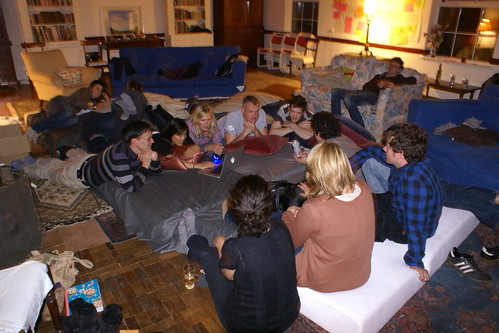
A few weeks ago a group of wayward individuals met at Waterloo station. We hitched a ride on a train going north into the English wilderness. Bertrand was forward-thinking enough to have brought beers for the journey, a skill he learnt in his 10 years working for Deutsche Bank as a structured equity derivatives trader. Next to him was Ingo. Ingo does things that make my mind hurt, which involves channelling and managing innovation and systems design, in Sweden. Behind me was Neil. He works for the Young Foundation, helping to design things called Social Impact Bonds, ways of allowing private investors to get involved in financing early interventions that might reduce social malladies. He was chatting to David, who specialises in design, and in particular, new means of mapping and visualising the financial sector. Bertrand started talking about social CDOs, and that's when people on the train started to look at us funny. A girl sitting next to me asked me who we were. Um, how do you explain that? We kind of work in finance, but at the same time are trying to disrupt it, alter it, play with it. I gave her my card. "Come to the dark side", I said, "there are cool things going on". Enter the Finance Innovation Lab.
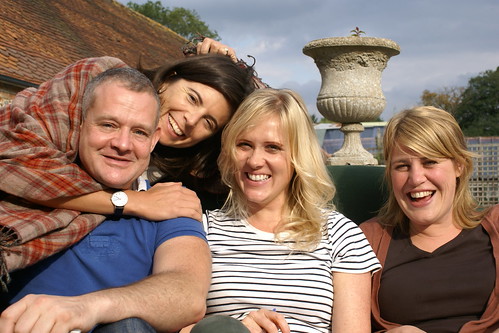
This is me, trying to talk on camera after three days of mind-disruption. We were talking financial reform and innovation, but most of all, the group of 21 of us were all together to discuss and map the potential future strategy and vision for the Finance Lab. The Lab was originally set up to bring people together under the common goal of finding out what a 'financial system that served people and planet looked like'. I'm a comparative newcomer to the group, but in the year or so that I've been hanging around I've seen the fantastic potential the Lab has to connect people, and to promote learning and collaboration. The next
challenge though, is how to scale it up to the next level, to bring in new streams of funding, target more people, and incubate more projects. Jen Morgan, Charlotte Millar, Richard Spencer, Rachel Sinha, Tina Santiago, Maria Scordialos, Vanessa Reid and Hendrik Tiesinga set up the frameworks to help us to think about these questions, and then let it run. A particular discussion point concerned the extent to which the Lab should shift from its current role as a facilitating and connecting organisation, to an organisation with a more explicit focus on advocating specific policies. The process of shifting to a more political stance isn't likely to be easy, but that why Chris Hewett has come in to explore the possibilities for 'finance policy for a green economy', with support from the Gulbenkian Foundation, represented at the weekend by Louisa Hooper.
SPOT THE EX-GOLD TRADER
Note the beautiful setting, on the grounds of West Lexham, a fantastic enterprise on an old converted farm. Manager Edmund wants it to be a hub for community empowerment, permaculture, renewable energy and creative solutions for sustainability, so that suited us pretty well. In our crew was Niahm, a whirlwind helping to drive WWF's sustainable food initiative, Tasting the Future - concerned with issues around sustainable food systems. We had Bruce, one of the guys behind peer-to-peer lending site Zopa, and now launching Abundance, a means for retail investors to put their money directly into financing wind farms and solar energy. We had the guys interested in unorthodox monetary systems - including Ben, pushing the boundaries of the monetary reform debate, and Leander, working on nurturing the complementary currency ecosystem. I shared a room in an old piggery with Maxime, representing both France and the socially responsible investment community.
PURE INNOVATION
The Fellowship of the Ning
BERTRAND SHARES HIS FEELINGS
The Finance Innovation Lab is a great space for those looking to get involved in designing a sustainable financial system. The first point of contact for those who are interested in getting involved is the online network hosted by Ning, but the core team is working on setting up a new website with enhanced capabilities. The plans are grand. By 2013, I expect we should own a large part of Canary Wharf. Until then, we get our strength from diversity. It's certainly not just for financialismos. It's for anyone with an interest in sustainability, creative design, systemic thinking, chaos theory, food systems, climate change, social justice, and last but not least, all those who just like causing a little bit of havoc.
Analysis of financial systems is still dominated by talking-heads and written punditry. The traditional financial website is all tables and graphs with numbers, cliched phrases and received wisdom, normally more confusing than enlightening. These approaches don’t come remotely close to conveying the emotional currents of the financial sector, the historical richness, the sociological complexity and the sheer chaotic surrealism. Art is frequently viewed as a financial asset, so why not treat finance as art? That’s what my new 'Financial Expressions' series will be about. It is aimed at exploring creative alternative ways of expressing financial information and ideas about the financial sector.
Raw Material: Back to basics with pure information
David McCandless was right to point out that information is beautiful. He's made a career out of finding pretty ways to present it, but sometimes even the most raw forms of information can have a gorgeous artistry. The beauty of raw financial information was first made apparent to me when I was introduced to the Bloomberg financial data terminal.
ISN'T IT BEAUTIFUL?
It looks like 1970s pop art, with an armour-plated keyboard, colour-coded keys and retro text set against a black backdrop like the old DOS systems. Its design seems to be inspired by old films of communist Russia, but for all its low-fi chic, the Bloomberg Terminal is one of the single most important items in the functioning of a capitalist financial system. The reason for this is that it provides raw information, live streaming prices of financial instruments and commodities, databases of company information, complex calculators to work out values and crunch statistics, profiles of individuals, and a lot of other stuff. It functions in a manner which serves to remind you that finance is an ancient art: It does not allow you to easily use a mouse to point and click on different options - you actually have to type in codes and hit ‘enter’. WEI gives you world equity indices, BTMM gives global bond markets. GRAB allows you to take a screenshot and email yourself a snapshot from a window into the world.
To me, the unique beauty of Bloomberg screenshots comes from the fact that they do not attempt to weave a coherent narrative around the information they present. If it's confusing watching the numbers jump around, it’s because confusion is the reality, and understanding is the abnormality.
Attempts to contain the chaotic nature of financial reality with clear stories must necessarily be shallow, but sometimes we need simplified realities. The following seven areas might be fruitful channels for those looking for creative routes to exploring financial complexities.
1) Sketching the system: Financial schematics
Thanks Brook
Schematics are a great way to simplify complex systems. Take the Shadow-Banking system for example. That's the vast labyrinth of securitised madness set on the wild shores of tax havens and the grimy jungles of London and New York. Need a map to navigate it? You sure do, lest you get eaten by an algorithm. Fortunately, the New York Fed was kind enough last year to develop a massive schematic to map it (see pg. 3). The map is so huge that to read the writing, one has to zoom the PDF to 300%. Alternatively, you can be like Brook Masters of the FT and print it out on a 3ft by 4ft sheet of paper. Take a look at it. Feel more enlightened?
Zerohedge did some great remixes of the map. The first is a circuit-board complete with a 'bailout chip' - try run this baby on your computer and watch the CPU explode and screen catch fire. The second is a Buddist Mandala - that's the Fed chanting soothing monetary aums.
Much work needs to be done in mapping financial systems with schematics. Mazes that people might want to take on include:
Internal structures and dynamics of a large bank (good luck)
2) Financial visualisations & infographics
Visualising information and packaging it with slick graphics is increasingly popular as a means to convey the basic essence of certain financial and economic issues. Infographics are especially useful for presenting statistics, which frequently mean nothing when served up blandly in tables. In a world exploding with stats, the infographics industry can only get bigger. Listed below are a few samples from some great sites.
There's also a whole world of infographic visualisation videos out there now. It's a fantastic medium, but I can't help but notice that a lot of these videos have become slightly formulaic variations on each other, sometimes a bit too slick, with flickering advert-like graphics and soundbites drawing seemingly clear messages from complex information. The financial ones have a tendency to depict bankers as fat men with top hats, which is slightly archaic, and suggestive of the fact that the people that make these videos probably don't hang out with bankers. That's especially clear when the technical mistakes slip in. Take this video about Glencore, the global physical commodity trader. It's visually stunning, but come on guys, Glencore isn't an 'institutional investor', as is claimed. I wish they'd get somebody to fact-check it if they’re going to go to all that work to create it in the first place.
Going forward, I think it would be great to expand collaboration between financial professionals and visual artists. An awesome example of fruitful professional collaboration on the economics front are the Keynes vs. Hayek rap videos, created by filmaker John Papola and economist Russ Roberts of George Mason University (and host of the great podcast, EconTalk).
4) Financial Haikus
Less is frequently more, so I've been trying to start a Twitter trend called #MarketHaiku. I'd like people to attempt to sum up the madness of daily markets in three lines with 17 syllables. Here are some examples (Ok, so these need some work still, but man is it fun):
#MarketHaiku 1: Volatility, is a five syllable word, bringing destruction
#PretentiousMarketHaiku 1: Wisened sage once said, To fear both the bull and bear, Is to fear nothing
#CommodityHaiku 1: Avocado, how tasty you are to me, all green and mushy
#PretentiousCommodityHaiku 1: I trade oil futures, and thereby make the present, the far distant past
5) Financial Landscape Art & Guerilla Semiotics
Andy Goldsworthy makes beautiful landscape art in the countryside, but I think we could do it within London itself, in financial zones such as The City, Mayfair and Canary Wharf. Banksy has long shown us that workscapes are pristine environments waiting to be subverted, but financial workscapes remain underrepresented in the urban subversion scene. There's a whole world of culture-jamming waiting to be unlocked, epic fireworks shows and small disruptions on the back of toilet doors. Who's up for stensilling the Wall Street Crash on the windows of Barclays Capital?
TOILET SUBVERSION: "CRASH JP MORGAN BUY SILVER"
6) Financial Performance art
Back in 2009 I had the rare opportunity to participate in an intriguing piece of financial performance art, run by well-known avant-gardista Haley Newman. A group of us stood outside the Bank of England and recited a mantra about consumerism. She called it Capitalists Anonymous. It was fun, albeit pretty bizarre. Let's design some more of these performances, because in a world characterised by absurdity disguised as normality, what do we have to lose, except dignity, and what's that worth anyway... (yo, get me the market price of dignity)
7) Markets and Music
Perhaps the most exciting idea for me personally, is putting music to financial markets. A while back, the FT commissioned composer Julian Anderson to create a musical piece interpreting the financial crisis. The result, to my ears, was underwhelming (listen to some snippets here). It's not just about notes and melodies, it's about texture of sound. A piano is not the right instrument for the financial crisis. You need electric guitars with fuzz pedals, amplifiers with built-in reverb and a moog synthesiser. A volatile market might be a Jimi Hendrix solo, set against a Les Claypool bassline of long term fundamentals. That's a future project waiting to happen. Anyone want to collaborate?
In the mean time, I thought I’d experiment with financial DJ decks and mash some Youtube videos together. I've found a radical combination: What do you get when mix an audio recording of a crazed S&P 500 futures commentator during last year's flash crash with a laid back bassline of 10ft Ganja Plant? You get Blood Money. It's not perfect yet by any means (and Youtube Doubler is pretty crap at synching - make sure both videos have a chance to load before watching), but I'm going to invest in some proper video editing technology so I can do this properly. Watch this space for my upcoming Youtube channel.
All these mediums offer potential channels for great creative madness, and maybe, just maybe, unorthodox routes to deepening our understanding of finance. If anybody has any other ideas, feel free to contact me. I'm always up for collaborating if you buy the whiskey.
Recently Google Maps has been blowing my (admittedly somewhat unstable) mind. It all started when I thought it would be great to travel around China, looking at Special Economic Zones. In the absense of cash to get a ticket to China though, I used Google Street View to drive through the outskirts of Hong Kong and to look longingly across the bay at Shenzhen, an economic engine on overdrive.
Virtual driving with Google streetview requires no petrol, but the system does rely on giant Google data centres sucking up huge quantities of electricity, so it ain’t exactly carbon-free travel yet. That’s a goal for the future, and in the spirit of a great transformation from carbon-intensive economies to a carbon-free one, I thought it would be interesting to use Google’s software to map the harware of global energy. Thus, I'm happy to introduce Suitpossum’s Map of Global Energy Geopolitics.
It's the beginning of an ongoing project to break the global fossil fuel nexus down into easy-to-digest chunks. It's being created in conjunction with another map (to be introduced later), tracing the emergent geography of renewable energy. Ideally, over the next ten years or so, the importance of the former map will diminsh vis-a-vis the latter
The map is still under development, but thus far, the points of interest are split into 4 categories:
1) Oil (and gas) fields
This includes the gigantic Ghawar and Shaybah Oil Fields in Saudi Arabia, and badass fields in other important oil-exporting nations, like the Samotlor Field in Russia and the Tengiz Field in Kazakhstan. I recommend checking out the enormous dying Burgan oil field in Kuwait, which can literally be seen from the sky (seriously, it looks like pools of oil are coming to the surface). That's the field that was set alight by Iraqi troops during the first Gulf War. Nowadays though, it appears to be the Rumaila oil field in Iraq that's on fire.
Another aim of the map will be to profile unconventional and controversial oil and gas operations, such as shale gas deposits, and the obnoxious tar sands excavations in Fort MacKay, Canada. These are the focus of much environmental concern, not to mention dubious economics.
2) Oil (and gas) Terminals
The map has some special points for those who are interested in the world of commodity futures trading. To the left is Cushing, Oklahoma, the theoretical delivery point for all those WTI oil futures contracts that the financial press always talks about. I say 'theoretical', because about 95% of oil futures trades are made by daytrading speculators who have never actually seen real oil, never mind actually taken delivery of it. Cushing has however, recently seen some interesting investigations into oil market manipulation by physical oil traders. Another point of interest on the map is Sullom Voe, stuck out on the wilds of the Shetland Islands. That's where the ICE Brent Crude futures get settled, and you can use Google Streetview to drive right up to the entrance.
Another fun one is Henry Hub, south of Erath Louisiana. This is where a load of natural gas pipelines in the US meet, and it's also where NYMEX natural gas futures get settled. A particularly interesting curiosity just north of Erath is Lake Peignure, made famous when oil prospectors in the lake accidently drilled through the ceiling of a salt mining operation below, causing the entire lake to drain in a swirling vortex of doom that made the river flow backwards from the Gulf of Mexico. More recently, the salt caverns of Lake Peignure have become somewhat controversial storage facilities for natural gas.
Do take a look at the other oil and gas terminals. There's a really interesting one in the murky delta at Bonny, Nigeria, and another in the far reaches of De-Kastri, Russia. There's the Sangachal Terminal in Baku, Azerbaijan, right in the heart of the oil and gas operations of the Caspian sea. Finally, there is the amazing R’as Tanura Oil terminal in Saudi Arabia. Take a look at the town - it hosts Najmah, one of the gated communities for foreign expats that work for the world's largest oil company - Saudi Aramco. See if you can spot the golf course. One might say that political opinions on all this are somewhat fractious: Check this pissed off dude.
3) Coal fields
This aspect of the map remains underdeveloped. Coal tends to be less of a geopolitical issue than oil, due to it’s wide geographic spread and large quantities, but it's certaintly the dirtiest fossil-fuel of them all. Over the next few weeks I will be identifying key coal zones, which shouldn't be too hard, considering that the coal strip mines are about as subtle as bomb zones.
4) LNG operations, and other curiosities: This is going to be a section to trace exotic curiosities like Gas-to-Liquids (GTL) plants, coal liquefaction facilities, and liquified natural gas facilities like the one at Ras Laffan in Qatar. Ras Laffan looks like a cross between Star Trek and Mordor, except set in a desert. Take a look at some of the photos available on the Panaramio tool on Google Maps.
5) Strategic transportation routes
Finally, the map will seek to point out various chokepoints in energy transportation systems, including areas of pipeline vulnerability, and shipping lanes like the Strait of Hormuz that keep US generals up at night, popping Valium.
This project remains a work in progress, so any suggestions are most welcome. Hope it can be useful.
So I haven’t managed to get a blog post out for a couple weeks. That’s partly because I’ve been having some cash-flow management problems, due to some crap planning on my part and some unfortunate payment delays. This is an ongoing issue in freelance life, to smile through gritted teeth when someone at an organisation tells you the admin guy went on holiday and forgot to process your invoice. In a situation when one’s reserves are marginal, small frictions in the system can wipe you out.
Needless to say, when my landlord sent me an sms a few weeks ago saying ‘You haven’t paid your rent, and you have six months of bills to pay too,’ I got a deep down chill. My landlord is a cool guy. He only has one name, and our contract is informal at best, built on trust and belief in human nature rather than legal structures. That’s why he gave me some leeway, and that’s also why I didn’t want to abuse that trust. So I called up my friend George, and asked him what I should do. He wrote a song for me with some suggestions about how to deal with the house rent blues:
It’s an ancient blues, the house-rent blues, and financial services for people suffering from cash-flow irregularities are probably as old as the moon. Short-term loans attached to long-term shackles have long been the speciality of a certain class of societal demon called the Loan-Shark. I’ve been seeing the Loan-Shark in my dreams, under a bridge, at the crossroads of Highway 61 and Highway 49, right there in Clarksdale where John-Lee Hooker wrote the song. In that dream the Loan Shark says “35% interest per month, secured on your soul” and hands me a contract to sign. “That’s pretty steep” I say, “Are you regulated by the SEC?” He’s taken aback. “Hell no brother, but you can count on me.” I look at the small print on the contract. It says: “You can check out any time you like, but you can never leave.” Yes it’s true, the Devil uses clichés from the Eagles.
The dark desert highway of the Loan Shark extends around the world. You find them in Brazil, you find them in them in South Africa. In Bangladesh you’ve got the ‘5-6’: The guy that loans you 5 taka in the morning, and gets 6 taka back from you at night. That’s 20% interest in one day, which is about 7200% interest annually, uncompounded. That what you call raping the time value of money.
Anyway, in dealing with my cash-flow problem I decided to stay away from Brixton’s loan sharks and to take a look at the legal pay-day loan services. Payday loans are like advances on a salary. You show them proof that you will be getting paid at some point. They advance you the money. You pay the money back with interest when you salary comes through. It’s a way to tide you over liquidity crises.
There’s a big new payday loan outlet that recently opened up by the Brixton Academy, opposite the St. Barnados Charity Shop. I had to wait for a while to get served, and watched a women in her early 30s sort of plead with them for a two-day extention on a £200 loan that she couldn’t quite pay back yet. I’m not sure there was a pleasant story behind her situation, and the lady who served her was gently refusing. It can’t be an easy job dealing with people on the thin-edge of financial stability.
LO-FI FINANCE
When my turn came, I got served by a young guy who was quick to tell me that the company is actually American, and that they have six outlets in the UK, the Brixton branch being a flagship of sorts. As for the terms of their payday loan: 25% per month, which is 300% per year, more modest than the classic loan shark, but ridiculous costly nevertheless. In order to get a £625 pound advance on your paycheck, you’d have to pay them back £780. I asked what would happen if I didn’t pay back in time. He said the matter is then passed on to their payment delinquency service, who would organise an ‘alternative payment plan’.
I reckoned I might check out some of the online payday loan services instead. Payday UK comes top of the search results. Again, the terms of the loan are 25% interest per month. Yep, for a £400 advance, you pay back £500 in a month. Wonga is another one, only this time it has a deceptively cuddly name and even worse terms: For £400 loan, you pay back £525 within a month. This really does not seem like a sustainable business model and people looking for £400 advances aren’t really the kind of people who should be spending £125 on liquidity management. There must be social enterprise models waiting to emerge in this space…
Out of curiosity I visited the pawn shop. Pawn shops allow you to pledge gold or jewelry as collateral in exchange for a loan. I didn’t actually have anything valuable to pawn, but if I did, their deal was better, at 6% interest per month.
WILL YOU ACCEPT MY AMULETS AS COLLATERAL?
The lower interest rate is a due to the fact the loan is secured on some valuable bounty, so if you don’t pay back, they just keep your stash. Collateral lowers your ‘cost of capital’ because it provides protection to the lender, and it’s one of those unfortunate realities that those who possess collateral tend to be wealthy individuals. Some might say that that’s a reason why wealth tends to concentrate around existing wealth… ahem, Mr. Marx.
So what do you do when you don’t have collateral to base a loan off? You label yourself an entrepreneur, and you raise money against the fabulous future wealth that you claim you'll create. That’s what I was thinking when I went to a talk on crowd-funding, given by Theresa Burton from a company called BuzzBnk. The idea behind crowd-funding is that you attract small-scale (philanthropic) investors to contribute to your cause. You need a catchy story to get people to invest in you though, and ‘Can you guys give me £400 so that I can pay my landlord’ is not going to cut it. On the other hand, ‘Can you give me £3000 so I can finish my book’ just might…. Did I mention that I’m writing a book? (more on this topic later)
In the end, time constraints required that I turn to the most powerful and ancient financial service: Angel investors…. By which I mean friends, the great providers of flexible and low interest loans. Thanks guys.
The moral of the story then is that I continue to live an unsustainable life and have a great new idea for an unprofitable business: A freelancers’ co-operative to help London’s army of freelance workers deal with the ordeals of invoice delays. This sounds like a good idea, to sink my energy into something which will have… um …. marginal and sporadic cash flows attached to it, at best.
But who needs stability when you have one bourbon, one scotch, and one beer…
As for how I defeated the Loan-Shark, I had another dream last night:
On Thursday I made my first appearance in the Ecologist, by all accounts one of the world’s leading environmental publications, founded in the 1970s. Yeah, airpunch!
The subject of the article was food speculation. It sounds obscure, but concerns around speculation on agricultural futures have been seeping into the mainstream agenda over the last few months in the context of rising global food prices. There is rising suspicion that the activities of financial players in commodity futures markets could have a distorting effect on futures prices, and thus that food price increases might be linked to computer algorithms running in some hedge fund in Mayfair.
WHEATBIX FUTURES
Having had experience in the world of derivatives, I’m always prepared to accommodate the idea that irrational behaviour in financial markets could distort prices. That said, I’ve remained cautious about populist arguments about why speculation must necessarily be a negative force. Thus, in late 2010, I attended a talk on agricultural speculation organised by the World Development Movement (WDM), who were one of the first to make a scene about this issue. I asked some difficult questions to the speakers and got thinking about the argument. Several months down the line, I ended up working with WDM on a report, and found myself joining a chorus of veritable shitstirrers raising awareness about the potential dangers of this issue.
The debate started a few years ago in the context of the 2008 commodity price spike. In the US, advocacy group BetterMarkets have been a leading critical voice advocating heightened regulation and position limits in agricultural futures markets. The US think-tank, IATP, has also been outspoken, recently releasing a compendium of useful articles they’ve published on the subject of excessive speculation. In the UK, WDM have been a trailblazer on the radical front for the last couple years, but more mainstream UK institutions have recently been catching onto this as well. Last month, Christian Aid added a bit of righteous anger in their report Hungry for Justice, and Oxfam is getting uneasy about it too. Then last week the UN global trade body, UNCTAD, added their stamp of disapproval towards ‘financialisation’ and poor transparency in commodity markets, with a hard-hitting technical report on the matter.
The UNCTAD report should hopefully add some more fire into the debate, which since 2010 has been somewhat stifled by an academically controversial, but politically safe report commission by the OECD. The OECD report’s authors, Scott Irwin and Dwight Sanders, claim to have found no connection between the increased participation of financial players in commodity markets and the crazy 2008 commodity spike. I’m all for healthy skepticism, but there’s something vaguely reminiscent of climate change denialism in the way that conservative pundits have latched onto this work as if it’s the final be-all-and-end-all of the matter. In real academic life, nothing can be settled with a single study, and the extensive critiques of this piece have been strangely ignored by the mainstream economic fraternity.
Certainly, this issue has the potential for highly polarised opinions. In January, Murray from WDM went head to head with Scott Irwin on CNBC, and to my mind, lays the smackdown on him. I mean, I’m sure Scott is a cool guy to hang out with at the pub, but he makes almost no attempt to engage here.
A similar level of disinterest is found in Terry Duffy, the chairman of the CME group, in his debate against the UN's Olivier De Schutter on BBC’s HardTalk in March. Terry says there’s no problem. Olivier says there is. Terry behaves like a condescending dick. Olivier doesn’t. Who should I believe?
For my part, I took part in a wheat price debate on the Farmers Guardian website last week. I suggested that farmers concerned about wheat price volatility should lobby financial institutions to spend less time investing in food prices, and more time investing in agricultural innovation and productivity. Failing that, I suggested farmers should band together, form a hedge fund, and use their superior knowledge of agricultural realities to outclass the precocious pseudo-farmers sitting in Barclays Capital. I got some enthusiastic responses to that.
I’d love to see that happen. What I don’t want to see happen is for this issue to go unscrutinised, only to lead to seriously serious fallout five years down the line. We've got to get the precautionary principle into action, so please do take a read of my Ecologist article, join the debate, and feel free to leave comments.
Do you know what a dirty dark spread is? To work it out you take the price of wholesale electricity, and you subtract from that the price of coal multiplied by an efficiency factor. What you’re left with is an indication of the profitability of a coal-fired power station. And we call that the dirty dark spread.
HOW DO YOU LIKE YOUR DARK SPREADS?
But why ‘dirty’? We call it dirty because there’s a clean version of the dark spread, called the Clean Dark Spread. It's basically the same as the dirty one, except it adds the price of carbon dioxide to the equation. What you’re left with is an indication of the profitability of a coal-fired power station within a system that explicitly puts a price on carbon. It's lower, but the key question is 'how much lower?'
The only reason we can make these distinctions is due to the existence of the carbon markets, brought into the fold through the Kyoto Protocol and the European Emissions Trading Scheme, perhaps the world’s most controversial market. 2010 though, saw the carbon markets tank amidst uncertainty over the future of global climate agreements, and last week’s Carbon Expo, held in Barcelona, undoubtedly saw carbon market participants doing some soul-searching. For quite some time, environmental finance has been associated with carbon markets, but the search for more holistic systems is leading to a shift away from pure carbon finance, to a broader focus on climate finance.
So tomorrow, the UNFCCC convenes in Bonn to talk climate in the run-up to December's COP 17 in Durban. The key question for passage-way conversations: How are we going to finance not only climate change mitigation efforts, which has been the focus of the carbon markets to date, but also climate change adaption? Another hotly controversial area is forestry finance. Two weeks ago, the Indonesian government finally signed a two year deal with Norway, in which Norway pays them $1 billion to limit licenses for forest logging. It’s the first major bilateral public climate finance deal, and a big step forward for the so-called REDD programme – Reducing Emissions from Deforestation and Forest Degradation. Nobody really knows how it’s supposed to work yet, but REDD is seen as a key pillar in any future climate finance systems.
The last few weeks have also seen some interesting progress in the UK, with the government launching the Green Investment Bank. The GIB will be in the business of project financing renewable energy and energy efficiency programmes, under the broader prerogative of moving Britain to a low carbon economy. Last week also saw the UK government releasing the National Ecosystem Assessment, an attempt at valuing the ecosystems of the British Isles. I have a vague feeling that, despite being at the cutting edge of economic research, trying to price an abstract concept like 'nature' will one day be looked upon in kind of the same way as we look upon eugenics, astrology, or other past pseudosciences. In the mean time though, it will, for better or worse, become part of the broader debate on ‘payment for ecosystems services’.
Outside of the arcane discussions about whether you can use financial options-pricing theory to value biodiversity, the real entrepreneurs are concerned with more practical matters. In the last month, I’ve been lucky enough to meet two guys separately working in the area of green bonds, credit instruments through which investors can lend money to environmental projects. These things are on the verge of going mainstream, with the IFC recently issuing green bonds to raise money for renewable energy. And that brings me to Luke, who I met whilst sitting in the Café at Foyles book store. Luke used to design algorithms for financial trading systems. Now he’s got a moleskine notebook with sketches for a new type of solar thermal tower which would use the sun’s energy to heat water to drive electricity-generation turbines. No mainstream bank is going to finance it – He needs renewable energy venture capital, an exciting and growing area of environmental finance aimed at the technology innovation market. “What I need,” he says, “is an old guy with too much money, and not enough time to spend it.” Maybe what he needs a government subsidy – like the feed-in tariffs – but the regulatory environment is getting pretty uncertain.
The most amazing thing about this all though, is that literally nobody has a clue on how it will all work out. We’re creating it right here, right now, ocean blueprints and forest greenprints. Will Luke’s solar project revolutionise the world? Will someone get venture funding to figure out how to harvest electricity from lightning? Will the green bond concept turn out to be a non-starting buzzword magnet? Will the carbon market exist in 10 years time? What innovation will emerge that we cannot yet conceptualise? Will Suitpossum be successful in designing a trans-generational environmental risk management system with almost no budget and a failing Wifi connection?
For more on all these topics, tune into the Suitpossum EnviroFinance series, starting tonight, and unfolding over the next several weeks on a computer screen near you.